12 décembre 2010
Billet destiné à tous ceux qui pensent que les blogueurs sont de gentils amateurs
Algebraic Geometry (math.AG)
- A Mind For Madness (subsection) - Matt Ward (U. Washington)
- Concrete Nonsense (subsection) - Alexander Ellis (Harvard), Sam Lewallen (Princeton), Yan Zhang (Harvard)
- Embûches tissues - Rémy Oudompheng (Nice)
- Motivic Stuff - Andreas Holmstrom (U. Cambridge, UK)
- Neverendingbooks - Lieven Le Bruyn (U. Antwerp)
- Rigorous Trivialities (subsection) - Charles Siegel, Matt DeLand, Jim Stankewicz
- Secret Blogging Seminar (subsection) - Scott Carnahan (MIT, Cambridge-USA), Joel Kamnitzer (U. Toronto), Scott Morrison (UC Berkeley), Chris Schommer-Pries (UC Berkeley), Noah Snyder (UC Berkeley), David E. Speyer (MIT, Cambridge-USA), A.J. Tolland (UC Berkeley), Ben Webster (U. Oregon)
- What's New (subsection) - Terence Tao (UCLA)
Algebraic Topology (math.AT)
- Rigorous Trivialities (subsection) - Charles Siegel, Matt DeLand, Jim Stankewicz
- Secret Blogging Seminar (subsection) - Scott Carnahan (MIT, Cambridge-USA), Joel Kamnitzer (U. Toronto), Scott Morrison (UC Berkeley), Chris Schommer-Pries (UC Berkeley), Noah Snyder (UC Berkeley), David E. Speyer (MIT, Cambridge-USA), A.J. Tolland (UC Berkeley), Ben Webster (U. Oregon)
- What's New (subsection) - Terence Tao (UCLA)
Analysis of PDEs (math.AP)
- What's New (subsection) - Terence Tao (UCLA)
- A mathematical melting pot - Antonio Ache (Wisconsin), Nestor Guillen (UT Austin)
Classical Analysis and ODEs (math.CA)
- The accidental mathematician - Izabella Laba (UBC)
- Lewko's blog (subsection) - Mark Lewko (U. Texas Austin)
- What's New (subsection) - Terence Tao (UCLA)
- A Day in the Life of a Wild Positron - Phil Isett (Princeton)
- Bounded Rationality - Samir Choksy and Edward Mehrez (UCLA)
- I woke up in a Strange Place - Ioannis Parissis (IST)
Category Theory (math.CT)
- Annoying Precision (subsection) - Qiaochu Yuan (MIT)
- Secret Blogging Seminar (subsection) - Scott Carnahan (MIT, Cambridge-USA), Joel Kamnitzer (U. Toronto), Scott Morrison (UC Berkeley), Chris Schommer-Pries (UC Berkeley), Noah Snyder (UC Berkeley), David E. Speyer (MIT, Cambridge-USA), A.J. Tolland (UC Berkeley), Ben Webster (U. Oregon)
- The n-Category Café - John Baez (UC Riverside), David Corfield (U. Kent, Canterbury), Urs Schreiber (U. Hambourg)
- The rising sea - Daniel Murfet (ANU)
- The Unapologetic Mathematician (subsection) - John Armstrong (U. Tulane, New Orleans)
- What's New (subsection) - Terence Tao (UCLA)
Combinatorics (math.CO)
- A Portion of the Book - Masoud Zargar
- Concrete Nonsense (subsection) - Alexander Ellis (Harvard), Sam Lewallen (Princeton), Yan Zhang (Harvard)
- Annoying Precision (subsection) - Qiaochu Yuan (MIT)
- Combinatorics and More - Gil Kalai (Hebrew U., Jerusalem and Yale U. New Haven) Some subsections: "Probability";"Computer Science";"Convex polytopes" and "Convexity";"Games" and"Rationality;"Riddles";"What is mathematics" and"Mathematics to the rescue";"Combinatorics" and "open problems".
- Euclidean Ramsey Theory - Kristal Cantwell
- Tim Gowers' blog - Timothy W. Gowers (U. Cambridge, UK)
- Lewko's blog (subsection) - Mark Lewko (U. Texas Austin)
- What's New (subsection) - Terence Tao (UCLA)
- SymOmega - John Bamberg, Michael Giudici and Gordon Royle (University of Western Australia)
Commutative Algebra (math.AC)
- A Mind For Madness (subsection) - Matt Ward (U. Washington)
- What's New (subsection) - Terence Tao (UCLA)
Complex Variables (math.CV)
- What's New (subsection) - Terence Tao (UCLA)
- Bounded Rationality - Samir Choksy and Edward Mehrez (UCLA)
Differential Geometry (math.DG)
- A Mind For Madness (subsection) - Matt Ward (U. Washington)
- Geometry and the imagination - Danny Calegari (Caltech, Pasadena)
- What's New (subsection) - Terence Tao (UCLA)
Dynamical Systems (math.DS)
- Disquisitiones Mathematicae (subsection) - Matheus
- What's New (subsection) - Terence Tao (UCLA)
- Mostly Maths (subsection) - Ruben Berenguel (U. of Barcelona, Spain)
Functional Analysis (math.FA)
- Tim Gowers' blog - Timothy W. Gowers (U. Cambridge, UK)
- What's New (subsection) - Terence Tao (UCLA)
- Epsilonica - Matthew Heath (IST, Lisbon, Portugal)
General Mathematics (math.GM)
- Bounded Rationality - Samir Choksy and Edward Mehrez (UCLA)
- Division by Zero - Dave Richeson (Dickinson College)
- Nathaniel Johnston's Blog - Nathaniel Johnston
General Topology (math.GN)
- What's New (subsection) - Terence Tao (UCLA)
Geometric Topology (math.GT)
- 392C: Geometric Group Theory - Henry Wilton (U. Texas, Austin)
- Secret Blogging Seminar (subsection) - Scott Carnahan (MIT, Cambridge-USA), Joel Kamnitzer (U. Toronto), Scott Morrison (UC Berkeley), Chris Schommer-Pries (UC Berkeley), Noah Snyder (UC Berkeley), David E. Speyer (MIT, Cambridge-USA), A.J. Tolland (UC Berkeley), Ben Webster (U. Oregon)
- Geometry and the imagination - Danny Calegari (Caltech, Pasadena)
- What's New (subsection) - Terence Tao (UCLA)
Group Theory (math.GR)
- Annoying Precision (subsection) - Qiaochu Yuan (MIT)
- Geometry and the imagination - Danny Calegari (Caltech, Pasadena)
- 392C: Geometric Group Theory - Henry Wilton (U. Texas, Austin)
- What's New (subsection) - Terence Tao (UCLA)
- SymOmega - John Bamberg, Michael Giudici and Gordon Royle (University of Western Australia)
History and Overview (math.HO)
- A dialogue on infinity - Alexandre Borovik (U. Manchester), David Corfield (U. Kent)
- Mathematics in Australia - Phil Broadbridge, Peter Hall, Birgit Loch, Terence Tao
- Mathematics Under the Microscope - Alexandre Borovik (U. Manchester)
- What's New (subsection) - Terence Tao (UCLA)
- Wiskundemeisjes - Ionica Smeets (U. Leiden), Jeanine Daems (U. Leiden)
- Women and mathematics EMS committee - S. Paycha, D. Perisic, Marjo Lipponen
Information Theory (math.IT)
- Lewko's blog (subsection) - Mark Lewko (U. Texas Austin)
- What's New (subsection) - Terence Tao (UCLA)
K-Theory and Homology (math.KT)
- Concrete Nonsense (subsection) - Alexander Ellis (Harvard), Sam Lewallen (Princeton), Yan Zhang (Harvard)
- Motivic Stuff - Andreas Holmstrom (U. Cambridge, UK)
Logic (math.LO)
- What's New (subsection) - Terence Tao (UCLA)
Mathematical Physics (math.MP)
- EMPG Blog - current members and alumni of the Edinburgh Mathematical Physics Group (Edinburgh, Heriot-Watt)
- Hydrobates - Alan Rendall
- Secret Blogging Seminar (subsection) - Scott Carnahan (MIT, Cambridge-USA), Joel Kamnitzer (U. Toronto), Scott Morrison (UC Berkeley), Chris Schommer-Pries (UC Berkeley), Noah Snyder (UC Berkeley), David E. Speyer (MIT, Cambridge-USA), A.J. Tolland (UC Berkeley), Ben Webster (U. Oregon)
- The everything seminar - Jim Belk, Greg Muller, Matt Noonan
- What's New (subsection) - Terence Tao (UCLA)
- The Language of Bad Physics - S.C. Kavassalis
Metric Geometry (math.MG)
- Frank Morgan's Blog - Frank Morgan
- Geometry and combinatorics - Konrad Swanepoel
- What's New (subsection) - Terence Tao (UCLA)
Numerical Analysis (math.NA)
- Nuit Blanche - Igor Carron
- The Endeavour - John Cook
Number Theory (math.NT)
- Annoying Precision (subsection) - Qiaochu Yuan (MIT)
- Disquisitiones Mathematicae (subsection) - Matheus
- Emmanuel Kowalski's blog - Emmanuel Kowalski (ETH, Zürich)
- Lewko's blog (subsection) - Mark Lewko (U. Texas Austin)
- London number theory - Kevin Buzzard, Minhyong Kim
- Noncommutative Geometry - Alain Connes (IHES, France), Masoud Khalkhali (U. Western Ontario), David Goss (Ohio State U.)
- Quomodocumque - Jordan S. Ellenberg (U. Wisconsin)
- Rigorous Trivialities (subsection) - Charles Siegel, Matt DeLand, Jim Stankewicz
- Secret Blogging Seminar (subsection) - Scott Carnahan (MIT, Cambridge-USA), Joel Kamnitzer (U. Toronto), Scott Morrison (UC Berkeley), Chris Schommer-Pries (UC Berkeley), Noah Snyder (UC Berkeley), David E. Speyer (MIT, Cambridge-USA), A.J. Tolland (UC Berkeley), Ben Webster (U. Oregon)
- What's New (subsection) - Terence Tao (UCLA)
Operator Algebras (math.OA)
- Noncommutative Geometry - Alain Connes (IHES, France), Masoud Khalkhali (U. Western Ontario), David Goss (Ohio State U.)
- What's New (subsection) - Terence Tao (UCLA)
Optimization and Control (math.OC)
Probability (math.PR)
- Bounded Rationality - Samir Choksy and Edward Mehrez (UCLA)
- God plays dice - Michael Lugo
- What's New (subsection) - Terence Tao (UCLA)
- Libres pensées d'un mathématicien ordinaire - Djalil Chafaï (Paris-Est Marne-la-Vallée)
Quantum Algebra (math.QA)
- Neverendingbooks - Lieven Le Bruyn (U. Antwerp)
- What's New (subsection) - Terence Tao (UCLA)
Representation Theory (math.RT)
- Annoying Precision (subsection) - Qiaochu Yuan (MIT)
- Concrete Nonsense (subsection) - Alexander Ellis (Harvard), Sam Lewallen (Princeton), Yan Zhang (Harvard)
- Neverendingbooks - Lieven Le Bruyn (U. Antwerp)
- Secret Blogging Seminar (subsection) - Scott Carnahan (MIT, Cambridge-USA), Joel Kamnitzer (U. Toronto), Scott Morrison (UC Berkeley), Chris Schommer-Pries (UC Berkeley), Noah Snyder (UC Berkeley), David E. Speyer (MIT, Cambridge-USA), A.J. Tolland (UC Berkeley), Ben Webster (U. Oregon)
- The Unapologetic Mathematician (subsection) - John Armstrong (U. Tulane, New Orleans)
- What's New (subsection) - Terence Tao (UCLA)
Rings and Algebras (math.RA)
- Concrete Nonsense (subsection) - Alexander Ellis (Harvard), Sam Lewallen (Princeton), Yan Zhang (Harvard)
- Neverendingbooks - Lieven Le Bruyn (U. Antwerp)
- The Unapologetic Mathematician (subsection) - John Armstrong (U. Tulane, New Orleans)
- What's New (subsection) - Terence Tao (UCLA)
Spectral Theory (math.SP)
- What's New (subsection) - Terence Tao (UCLA)
Statistics (math.ST)
- Statistics How To - Stephanie Kenrose
- Statistical Modeling, Causal Inference and Social Science - Andrew Gelman
- Arthur Charpentier's blog (Univ. Rennes 1) - Arthur Charpentier
- Three-Toed Sloth - Cosma Shalizi
- What's New (subsection) - Terence Tao (UCLA)
- The Endeavour - John Cook
- Xi'an's Og - Christian Robert
- Fishing in the Bay - Chris Lloyd
- Research tips - Rob J Hyndman
- Psychology and Statistics - Jeromy Anglim
Symplectic Geometry (math.SG)
- What's New (subsection) - Terence Tao (UCLA)
Problem-solving
- The polymath blog - Tim Gowers, Gil Kalai, Michael Nielsen, Terence Tao
- Todd and Vishal's blog - Todd Trimble, Vishal Lama
Software and publishing
Popularization of mathematics
- Numb3rs - Mark Bridger (Northwestern)
Other applications of mathematics
- Nuit Blanche - Igor Carron
Miscellaneous / Uncategorized
- "Mathematics Rising" - Joselle Kehoe (UT Dallas)
- Richard Borcherds' blog - Richard Borcherds (UC Berkeley)
- Peter Cameron's blog - Peter Cameron (London)
- Maxwell's Demon - Edmund Harriss (University of Leicester)
Theoretical Computer Science blogs
Please see this page.
Page source: ICI
15:48 Publié dans La Recherche | Lien permanent | Commentaires (3) | Tags : blog, blogs, blogs de maths |
| |
Imprimer |
11 décembre 2010
Les Inclassables aux mois de novembre
17:37 | Lien permanent | Commentaires (0) | Tags : wink, présentation, geogebra, blog, statistiques |
| |
Imprimer |
17 août 2010
Sur Internet on discute de tout et de rien, donc de la preuve de P=NP !
Tout a commencé il y a une quinzaine de jours lorsqu'un mathématicien ingénieur a mis en ligne les éléments d'une preuve de l'un des problèmes mathématiques les plus difficiles à savoir si P=NP.
Pour les non-matheux, j'imagine que cela n'évoque rien et pour les matheux moyens, comme moi, la vague idée que c'est un problème ardu qui traite de la complexité des algorithmes et qui rapportera un million de dollars à qui le résoudra (s'il accepte la somme... elle vient d'être refusée par le mathématicien russe Perelman pour un autre problème).
Le mathématicien s'appelle Vinay Deolalikar et sa publication a mis la communauté mathématique internationale en effervescence. En effet, les commentaires sur les blogs, forums et les wikis n'ont pas cessé depuis la publication de la preuve sur Arxiv, il y a une quinzaine de jours.
Il en reste des traces un peu partout et en particulier:
Sur le blog de Terence Tao, qui rappelons le au passage fut Médaille Fields.
Sur le blog Gödel lost letter and P=NP.
Une semaine: c'est le temps quil aura fallu pour que deux failles importantes soient trouvées par les mathématiciens les plus talentueux dans cette preuve qui aura fait beaucoup parlé d'elle.
Ce qui est surprenant dans cette histoire c'est d'une part le niveau de technicité et d'expertise que peuvent prendre des échanges sur la toile, ce qui contredit largement l'idée selon laquelle Internet serait un lieu d'échanges de seconde zone et d'autre part la rapidité avec laquelle se sont faits ces échanges.
Même si l'on n'est pas sensible aux sujets mathématiques on ne peut qu'être interpellé par cette révolution permise par le monde numérique dans l'accès aux documents, leur diffusion et les discussions qui en sont issues.
Le New-York Times a d'ailleurs rédigé un article sur ce sujet, pointant l'étonnant pouvoir collaboratif de la Toile. A lire de toute urgence !
20:04 Publié dans Constructions, Débats, Défis, Infos, La Recherche, Mathématiques, Monde numérique, Outils web, Représentations | Lien permanent | Commentaires (0) | Tags : p=np, collaboration, web2.0, web, blog, wiki |
| |
Imprimer |
22 juin 2010
Publier des maths sur un blog Blogger à partir de Google Documents
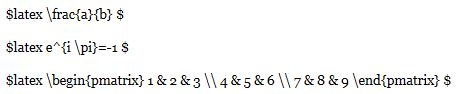
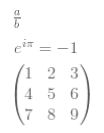
Vous savez sans doute qu'il est possible d'insérer du code Latex dans les documents "Google Document".
Une option permet d'exporter ce code vers un billet de blog Blogger ( il faut en créer au moins un !).
Il suffit pour cela de cliquer sur le bouton "Partager", en haut à droite du document, de demander l'exportation vers une page HTML et de regarder non pas la première possibilité (export HTML), mais la seconde. L'option d'exportation dans un billet de blog apparait:
Cliquer sur l'image pour l'agrandir.
L'écriture s'avère simple pour un résultat tel que celui-ci.
Si vous ne connaissez pas Latex, il suffit de l'apprendre avec l'éditeur Latex en ligne CodeCogs.
12:12 Publié dans Outils web, Pour le prof de maths | Lien permanent | Commentaires (0) | Tags : google, blog, publication, latex, mathématiques |
| |
Imprimer |
16 mai 2010
Embarquer une animation Jmath3d sur un blog
Jmath3d est un applet Java qui permet de réaliser des animations, des visualisations d'objets de l'espace: patron, solides, sections planes, surfaces. Placer l'une de ces animations sur un blog peut être intéressant en collège comme en lycée. Je pense principalement à l'outil permettant de déployer des patrons de solides.
Cliquer sur l'image pour accéder à l'animation ( je ne peux pas l'importer ici, Hautetfort refuse les codes des applets)
Je suis toujours un peu surpris, de ce qui est indiqué comme facile à faire, me pose toujours des difficultés techniques lorsque je m'y essaye. Mais à force d'enregistrements successifs je suis parvenu à placer des animations Jmath3d sur mon blog. J'ai principalement rencontré quelques problèmes lorsqu'il a fallu enregister le fichier "code source" généré avec une extension .g3 du générateur de surfaces afin qu'il puisse être lu par l'applet. Mais reprenons au départ.
Pour insérer l'applet dans un billet de blog (qui l'accepte), c'est très simple, il suffit de recopier le code HTML donné dans l'éditeur HTML du blog. Il faudra ensuite remplacer le nom du model par l'adresse de votre fichier ou l'adresse d'un fichier présent sur le site de Jmath3d avec un clic droit de souris sur le lien puis "enregistrer l'adresse du lien". Jmath3d lit des extensions .g3, .obj et des fichiers Geospace ( non testé).
Les générateurs du site permettent d'obtenir le code que l'on doit placer dans un fichier .g3. Ce fichier devra être placé sur un espace personnel à l'aide d'un client FTP (Filezilla par exemple). Il suffira ensuite de récupérer l'adresse et de faire le remplacement à l'emplacement indiqué ci-dessus.
Pour enregister le fichier, j'ai utilisé Notepad++, Fichier>nouveau puis j'ai copié le code. C'est ensuite que j'ai du effectuer de nombreux essais pour parvenir à une version de fichier lisible par l'applet. Certainement que je ne m'y prends pas correctement mais j'y suis parvenu.
Dans Notepad++, il faut sélectionner XML dans le menu Langage et dans le menu Encodage "Encoder en UTF-8 sans BOM", puis "Enregistrer sous" et mettre le nom du fichier avec l'extension .g3 dans le champ de saisie. Cependant après cette opération, le texte coloré passe en noir et n'est visiblement pas reconnu par l'applet. En réengistrant une seconde fois, le code redevient coloré et visiblement cela passe correctement à la lecture. Dans tous les cas il faut faire attention à ce que le code ne soit pas modifié (racines carrées, puissances..) après la sauvegarde:

Voilà les différents résultats que j'ai obtenus sur mon blog "Maths au lycée". Il est possible qu'il y ai des problèmes pour afficher toutes ces animations ensemble, sélectionnez les une par une.
13:58 Publié dans Pour le prof de maths | Lien permanent | Commentaires (0) | Tags : jmath3d, applet, blog, tutoriel, espace, géométrie, polyèdre |
| |
Imprimer |